Hello friends, well-wishers, and passers-by,
I thought that I would give you a brief glimpse into the workings behind this project. Once I'm finished with the project – at least this incarnation – I will elaborate in more detail, but for now, I'm just going to answer a few questions/comments I get on a regular basis:
1. "Are you going to be staying in shelters and living with the homeless?"
No, I have not been staying in shelters. I have hundreds of dollars worth of equipment on me that I don't want to get stolen – most of which is integral to the project. I stay at friends and families' houses, and I've also stayed with people from CouchSurfing.org.
2. "So do you just approach people on the street and talk with them?"
No, and not because of fear, but for simple self-respect. As I am a person who does not look homeless and who has zero background with the homeless, I do not want to just approach a random person and ask them to elaborate about themselves. Some might say that I could get away with doing this, that some homeless people might be really open to it, but I personally don't feel right about doing so. I always go through ministries or shelters.
3. "How many shelters do you plan to visit? We have plenty of shelters here in ::insert town/city here::."
Usually, because of time and travel restrictions, I have only had time to visit one shelter. There has been an instance or two where I probably could have gone to more shelters, but for the most part, I've been restricted. Also, I have learned as I've gone along that it's good to communicate with the shelter beforehand. Sometimes it takes them a day or two to find a couple people for me to talk with, and as I'm only in a certain place for a limited time, it usually seems/feels like I'm on a time crunch; also, not every shelter/ministry has been receiving of my intentions, though the majority have. I would not be opposed to talking to numerous homeless people from the same area, but also, my goal has been to chronicle the homeless around America. For me, this means not focusing heavily on one place.
4. "How are you getting around?"
In Kansas City, Missouri, I was informed of a Greyhound pass that allows you to have unlimited travel for a month, so I've been using that to get around. I'm pretty sure it's the cheapest way to travel in the States right now, unless you want to hitchhike. Once I get to the Greyhound station, friends, family, or Couchsurfers will pick me up. After that, I am pretty much reliant on them for rides. Unless I get used to the layout of the city, I am awful with public transportation and figuring out how to get around. Were I to take a public bus around any given town, I would get lost without question.
5. "How long are you going to be out and about?"
A fantastic question! I'm not sure.
I hope this has answered some questions for you, if indeed, you had any questions about this endeavor. If anybody has a question for me, feel free to post it in the comments section.
I'll be posting a new profile tomorrow. Stay tuned!
Thursday, May 5, 2011

Wednesday, May 4, 2011
Ezekiel from Kansas City, Missouri

Ezekiel, 36, is from Kansas City, Missouri, and while he has never been homeless, he has experienced everything the dark side of life has to offer. He has undergone severe poverty since his childhood and suffered physical and emotional abuse from family, friends, and peers. For a time, he was addicted to drugs and alcohol. This life of pain produced in him a self-loathing that haunted him for years, and it is only recently, through accepting Jesus as his Savior, that he has been able to break the cycle of poverty in his life.
After his family moved to Laredo, Texas, Ezekiel admits there were neverending difficulties. Both his mother and father were uneducated, neither could find work, and all they had was a cramped, rundown apartment. "It was like a half-bedroom," he jokes. He and his two siblings slept on a mattress outside of their parents' bedroom door. They couldn't afford heat, nor did their shower work, so their mother bathed them outside with water she heated up from the stove. They had to constantly borrow food from family and friends, and their mother would pick up clothes for them in the trash. For years, his parents would argue and his mother would threaten to leave the family. "We'd be screaming from the backseat of the car, our voices pleading with her not to leave," he says. "She couldn't leave because she had no place to go either." Essentially, Ezekiel lived in Depression-era conditions, except in the context of the late Seventies.
When his parents eventually found jobs, they had to find a place for Ezekiel to stay during the summers while they were at work. He would get dropped off at his uncle's house, but it wasn't the ideal place for a small child to be. "They would party and drink a lot and always have lots of people over..." At the age of 10, Ezekiel experienced abuse at the hands of his extended family. "At some point, I didn't know why or what was happening, but my aunt and some of my cousins molested me... I felt lost, I couldn't tell anybody. I mean, who would I tell anyway? This was part of my dad's family, I couldn't just say, 'Hey Dad, by the way...' you know?"
From kindergarten to high school, Ezekiel had to struggle with constant bullying because of his family's poverty. "I was the dorky kid everyone would pick on," he said. "They beat me up, they called me names, they would steal my lunch money – it's stuff you see in the movies, but it actually happened to me." It didn't help that basic hygiene wasn't taught to him. Because of his trashy clothes, he would smell. He also admittedly had bad breath and he earned the nickname "Skunk" during this time. More than once, bullies would take him to a back alley, beat him, and say, "'Skunk, you look a little dry' and then they would pee on me." Because of his lack of a support system, Ezekiel didn't know how to make sense of the bullying. "I grew up thinking, well, maybe I am ugly. Nobody liked me or wanted to be my friend."
On top of the bullying, Ezekiel barely continued forward in school. Near the end of 6th grade, he discovered that he would have to stay behind. "I didn't want to stay, I wanted to get better," he said, so he sought out tutors that helped him pass to the next grade. While he still had to take mostly special-ed classes in 7th grade, he was allowed to take a computer class with the "normal" students. It was in this computer class where a teacher first challenged his way of thinking about himself: "My teacher said, 'Ezekiel, why don't you look in the mirror every morning and tell yourself, you are beautiful. I don't know if she saw the bullying or anything, but I believe God sent her to me. I went home, looked in the mirror, and I couldn't see myself clearly. I hated myself. Finally, I got a good look and said it, said, 'You are beautiful.' I thought I was crazy." Soon after, he said this to himself again in what he thought was an empty classroom. Some kids overheard him and made fun of his admission. "After that, the negative feelings came back. I felt like I was back at square one."
While Ezekiel had given his life to Christ at age 16 at youth camp, he says, "I didn't really know what it meant. I went up to the front because everyone else was doing it." He had no mentor or pastor to guide him into a life with Christ, so he continued to do whatever numbed his internal pain. High school came and went without him graduating, and as a result, Ezekiel says, "I turned into a lazy bum." Feeling directionless without a job or school, he began to hang out with "the wrong crowd." "My friends liked to party, drink, do drugs. That's when I started doing all of that stuff. I liked it so much, those same friends thought I needed help! That's how bad it got. For awhile, anyway." During this time, his father enrolled him in a private Christian high school – something he worked extra hours to maintain – but the only thing Ezekiel took away from there were two Christian friends he made named Jeremy and Charlie. For the first time in his life, Ezekiel felt like he had met people who genuinely liked him for who he was. He ended up not finishing at the private school and instead, obtained his GED through a program at the local community college. Nevertheless, his time with Jeremy and Charlie would influence his direction towards Kansas City, Missouri and his eventual salvation.
Soon after getting his GED, Ezekiel wanted to move out of Laredo, Texas. Jeremy and Charlie had moved to Kansas City, Missouri and had invited him up to move in with them. They were insistent upon him coming with them. "My dad got frustrated because they would call me every morning. Seriously." Eventually, his dad gave him some of his own money for a bus ticket and he left to go live with his friends. "I didn't have a plan or a future, but I was out of Laredo."
Ezekiel saw Kansas City as a means of escape from Laredo and the negative influences in that town, but he continued to struggle with his life choices there. "I got into a gothic group called 'The Crow,' after the movie. We would drink and take drugs, but they were also into really perverted stuff, like making out with each other. They also pretended to be vampires and sucked on each others' blood. It was unbelievable." During this debaucherous period, he was pulled over several times for having no car tags or insurance. Eventually, he was arrested and had to go to jail for a couple nights before he could go to court. It was here that he began to be serious about his faith: "I was trying to get help [in jail], but no one was helping me. There was no way out. So when I was there, I cried out 'Lord, if you get me out of this mess, I will do whatever you want.' Of course, anyone would say that, but I know now that the Lord held me to it.'"
After his brief stay in jail, Ezekiel became plugged in with a church in Kansas City, Missouri named Solomon's Court. It was here where he met his mentor, the head pastor named Mark Schmidt. Pastor Schmidt even allowed Ezekiel to stay with him for awhile because his friends, Jeremy and Charlie, had kicked him out over his lifestyle. "I didn't have any wisdom, knowledge or responsibility. The pastor took me in anyway. He saw something in me that I didn't see." Instead of allowing Ezekiel to linger on his couch, the pastor put him to work. Before church one Sunday, Pastor Schmidt brought him down to the church basement. "The janitor brought me a mop and he said, 'I want this basement spotless and clean before church starts.' I was complaining the whole time I cleaned, but I realize now that the Lord was teaching me discipline and responsibility." Once Pastor Schmidt saw that Ezekiel was serious about turning his life around, he enrolled him in some Bible classes. From there, he started working in ministries to feed the homeless, and has been engaged with the church ever since.
Today, Ezekiel's life has been completely turned around and he is using his own life experiences to bless others. He is the youth pastor of Restoration Church in inner-city Kansas City, Missouri; he is on the Healing Team at the International House of Prayer; and he's also on the staff at the Kids Center in Hope City, a homeless outreach. In regards to his youth group, where he says many leaders have simply left the kids because they couldn't handle the stress, he states, "I made them a promise. I told them I'm not quitting on them because I don't want to be one of those who has gotten discouraged and left. I just love them." In reflection upon his own life, Ezekiel ponders, "I feel like I was like an onion and God just had to peel off all my layers of hurt and pain. He had to break down walls.... Being connected with the International House of Prayer and Hope City and Restoration Church and now having friends from all around the world [through IHOP], I can see that the Lord has brought back what the enemy has stolen from me, and doubled it. Thinking of myself when I was younger and looking at myself in the mirror now, I can say, 'Yes, the Lord has made me wonderful.'"
Monday, May 2, 2011
Will "Zubanello" - Tulsa Day Center for the Homeless

Unlike many that I've interviewed, Will has experienced both prosperity and poverty. "I was married for twenty-four years. We had five children. I've always worked. Some of the jobs I've had [during my marriage] are working at a tire plant, making tires for Firestone in Des Moines, Iowa – where I'm from. I made really good money. I worked for T.D. Williamson here in Tulsa, welding. In the years I've lived in Tulsa [at a time where I wasn't homeless], I've helped build the Promenade Mall, the South Roads Mall, the third story on the Dillards out at Woodland Hills Mall. I worked in the state of Wyoming and managed a log home business, and unfortunately, because I fired a young man who didn't want to do his job, he went and talked to his father who was an outstanding attorney in the state of Wyoming. His father filed a lawsuit that was a defamation of character against the company and it was easier for them to get rid of me than to fight a lawsuit. I ended up being on the streets in Cheyenne the last month I was up there. I went from driving a $60,000 Dodge mega-cab 4x4 truck and having a nice home to live in – that were perks of managing the company – to going back on the streets and walking around with my bags, being embarassed, people knowing me in the Cheyenne area. I think if anything about... being homeless is the worst, it's the embarassment. I never once thought I would be in this situation."
Will doesn't feel that some who survive with the help of the Tulsa Day Center want to escape from their current homelessness, and that the Day Center is partially to blame for that. "If you've got that kind of situation where people are so freely given the easement of life, in a sense, a lot of them won't go out and find the work, whereas guys like me who want to work and want to get their butts out of this situation, in some ways, can't in the city of Tulsa.... Some people here [at the Day Center], a lot of them are very nice.... There's several people here... I guess you might call them 'holdovers' and they've never left because they don't know what to do in real life. They're stuck here in this environment. In some ways, you can tell who they are. I think the Day Center... tries to help people, but in some ways, I think they make it too easy for people to stay here. I'm not a guy who likes a lot of rules, but I'm starting to think that this system is wrong. Maybe they should change it and make things more limited, as far as like a timespan that people can stay here. People aren't leaving. When the economy gets better, I think a lot of people will leave. But the economy hasn't gotten better."
As Will reflects on his life, he reveals his belief that, some of his difficulties in finding a job, stem from the current economy. "Right now, I'm 59 years old. I'm a father of seven [with two children from a previous marriage], a grandfather, and a great-grandfather. I never once thought I would be in this kind of position in my life. I've owned four houses through the years – new homes. I've worked all my life. I've been married three times, but I've always bounced back. Now because of the way life is and how the economy is, we've sold so many of our jobs overseas that a lot of the work that people used to depend on and live by, you can't depend on it anymore. I'm a machine operator, a welder, and construction worker. A lot of [people without jobs] can't go back to this kind of stuff because there's just no jobs. When you've got that kind of environment... it just creates [homelessness]."
One particular experience has shaped Will's outlook on his own homelessness. "One of the most embarassing situations I've had since [I became homeless], when I was in the program over at Salvation Army to go and get drug tested – which I understood – but they would not allow us to leave our belongings over at the Salvation Army. We had to drag suitcases, plastic bags with clothes in them... to the rich side of town here in Tulsa. Kids in nice cars were going by and saying 'Look at the homeless! Look at the bums!' We're sitting here carrying what we own, unfortunately, and being forced to do that, and these people aren't used to seeing people in their neighborhood like that. It was truly one of the most embarassing things I've had to do in my life. In fifty-nine years, I've been through quite a bit, but that was a mind-shaker for me."
Right now, Will survives day to day, like every individual experiencing homelessness. He has a plan for his future, but he doesn't see a way out of his current situation. "My main concern is, with my age and stuff, I'm not a person that's going to be hireable. I've got things figured out that, when I turn seventy, the Marine Corp and the VA are going to give me money for retirement to live off of. I've held [money] back all these years, so I will be ok. But right now... I just have to live like this. When I came back [to Tulsa], I honestly thought I could stay with my kids, but it just didn't work out." Will did not elaborate on his relationship with his children.
He continues: "I'm gonna go back out [to the Day Center] in a minute and carry [my bags] to the shelter that I stay at here in Tulsa and wait to see if I even get a bed. I served my country three times in Vietnam. I did thirty-nine months in the Vietnam War and I have to live in a shelter. It just doesn't seem right. That's where I'm at right now. I've personally gone through my own hell dealing with this and I wouldn't wish this upon anybody. I really wouldn't."
Wednesday, April 27, 2011
Robert from Beautiful Feet Ministries

Robert used to do temporary contract work when he was younger, but after fifty, he started experiencing health problems. "I had a heart attack, and after that, I couldn't do those hard things. I had to back off and now there's no money or much of anything, except to sit at the bottom with picking up cans, looking through trash cans, dumpsters. Whatever I can do to get a little bit of either money or food... that has become my life because of getting old. I just turned fifty-five this week. I don't know what I'm going to do now. I suppose I'm just condemned to this unless some miracle happens. I don't see any way out of it."
Robert divulged about how he survives on a daily basis in the homeless camps around Fort Worth. "The camping is something I had to learn because I come out on to the streets, like a lot of people, not knowing. I have had to learn how to gather food, to keep water. I had to learn how to get light... I get some wax, take it as cheap as I can get it, make me a wick and a can lid, and melt that wax over that wick to get my light. I had to learn how to get materials to build me a shelter, I had to learn places to go and not to go. Some people are real touchy about private property, but then there's other places people just don't care. Wherever I'm at, I'm being quiet. You do everything you can to keep from being noticed in that spot. When you see people gathering up together, you've got to get away from them because the law enforcement aren't going to allow tent cities."
For Robert, it's living out in nature that presents the biggest trials. "Protecting yourself from the weather, especially the wet. You don't realize how moisture can get to you. Even if you're not in the rain, that humidity just soaks into stuff. I try to save clothes that I get from Christian people – they will get moldy, they will just fall apart. That has been a learning experience for the last ten years... the older I've gotten, the more susceptible I am to the elements. Cleaning up is maybe the biggest problem because, in a camp, if I take my clothes off, I've got mosquitoes to deal with. And when there ain't that, it's the cold. I have had experiences, like I tried to use river water to wash, but then I got an infection once from a little cut on my arm. It turned into a nightmare. I had red streaks on my arm, one hundred degree temperatures, all my lymphnodes swoll up, it was horrible. So I've had to learn how to deal with that too. A lot of times I just don't deal with it."
Robert doesn't seek out shelters for a place to stay because he feels it makes you too reliable on the system. "At least for me," he stresses, "I would just be injecting myself onto a situation where I can't maintain myself; to where I'm constantly dependent on the government to give me a check here, food stamps there or whatever. Besides, a lot of these places, I can not stand: the walk-in missions, the Salvation Army, being around that crowd of people, I can't stand it... That's why I decided I'd get as good as I can at camping."
Mike Myers of Beautiful Feet Ministries has helped Robert visualize how to best live his life, regardless of if he's sleeping on the streets. "Reverend Mike has said that we have the wrong 'T' word; that we're 'trying' instead of 'trusting.' I started trying to integrate that into my mind because I would push so hard with stuff and my physical capabilities were such that I couldn't push hard. Gradually, I saw how, if I just kept moving, God would fill in the blanks in odd ways that would totally surprise me. So I stopped pushin'. I just wander around and I do the best I can and I get what I need. The 'trusting' thing has... really kind of changed my life. It's hard to say that, after fifty years that one thing like this could make so much difference. It's about not worrying and always having that faith in God. Of all my experience, [trusting] and forgiveness has made all the difference."
Despite his circumstances, he sees God's provision through every situation. "God has helped me with all those things: the camps, food... there's nothing he hasn't helped me with. He's let me know that His joy was what I needed and that it was better than any of those things because it's complete. I was the type where, if I'm about to run out of something... I'm already worrrying about it. It was really hard for me to look at God first for all those needs. The 'trying' and 'trusting' thing was what turned me around. I stopped worrying about it."
Monday, April 25, 2011
Kenny and Beautiful Feet Ministries from Fort Worth Texas
Kenny is the first of three people that I'll be profiling from Beautiful Feet Ministries. Beautiful Feet is an organization located south of downtown Fort Worth, Texas. They provide a substantial amount of ministries to the homeless and poverty-stricken. Just a few: breakfast and lunch every day (usually from places like Starbucks and Central Market), free medical care one day a week, dental care every day, children and youth ministries, and if they have them, jobs to those in need. You can find more info on Beautiful Feet at http://www.thefeet.org/. I didn't get to spend as much time there as I did at Hope City or Home PDX, but they seemed like a fantastic organization. I met with the director Mike Myers and his compassion and intensity for the ministry was very evident.

Sadly, I was not able to take Kenny's picture. I know he would have let me, but I simply forgot to ask during our conversation. When I looked for him later, I couldn't find him. Poor planning on my part and I apologize for that. To give a visual impression, Kenny is a tall, middle-aged black gentleman. He had gray and black curly hair. While his height made him physically imposing, his face and manner were very gentle and kind.
Kenny is originally from Louisiana, just outside of Baton Rouge. He grew up poor in the country as one of nine siblings. He never married and he says, "I don't know if I got any kids." He pauses before chuckling. "That's the truth!" He worked offshore for the Shell Oil company in Louisiana for fifteen years before moving to Fort Worth in 1991. When he arrived, he noticed that "a lot of the industries around here was closed up." The lack of work coupled with his drinking habit led him to the streets where he's been, off and on, for fifteen years.
Beautiful Feet Ministries has helped him get back on his feet and stop drinking. "I used to be a terrible drinker at one time. There was a bar called Bucket of Blood over on Hattie St... I got out of the bar one night and went to the parking lot. These guys tried to rob me and they were beating me up. They was kickin' me and punchin' me. I was dead drunk, but I remember them beating me up. Reverend Mike [the leader of Beautiful Feet] and them would go out and preach street ministry on Friday night. They had just gotten a white van... looks like a police van. They pull up, they had the big light shining like the police. All the guys thought they was the police and they ran. That's when Beautiful Feet picked me up and threw me into Detox... [Beautiful Feet] is a real good thing. I do what I can to help them."
Elaborating on Beautiful Feet Ministries, Kenny says, "The majority of the people that come here. Most of them are just down on their luck. Some are alcoholics, some drug addicts, lot of people have apartments, but it's the end of the month now. All the aid people get from the government, that's run out now. We're very dependent on places like this to make it from day to day." Kenneth says everyone's welcome here, "as long as you're not too crazy. Most of the people I know appreciate [Beautiful Feet], but then you got some that... it don't matter what you do for 'em, they ain't gonna appreciate it!"
When asked what he's learned from sleeping on the streets, he replied, "You learn a lot of different ways of doing things. Let's just say, you have to make twenty dollars and make it last until the next week. Tell me that ain't stretching it!" he laughs. "I've known a lot of different people out here. They lose their job, they lose their apartment, then you start living in a car. You lose your car 'cause you ain't got nothin', the next thing you know, you're homeless.... Things just happen in life. You don't know why, I don't know why. Accept it and keep going."
He continues, "With my little experience, it's been the younger generation coming out and being homeless. They can't find any work. Who knows where it's going to end, I have no idea. This economy as bad as it is, it hurts everybody. It hurts the homeless even more because they don't have the access to go find this job or that job. Everybody has a different story, different reasons for being here."
For him, shelter is the most difficult commodity to obtain. He says that if he got a job, he would seek out an apartment. "Absolutely, that would be the first thing." For now, he sleeps anywhere he can find shelter. "I get away from everybody so I don't have to worry about it. The farther out you get, the better you are, especially if you're by yourself."
For all the troubles that come with being homeless, Kenny has accepted this way of life for now. "When you're out here, not knowing what you're gonna do the next day is a trip. Something comes your way, you just do it. If it don't, you just thank God you're livin' and keep on going."

Sadly, I was not able to take Kenny's picture. I know he would have let me, but I simply forgot to ask during our conversation. When I looked for him later, I couldn't find him. Poor planning on my part and I apologize for that. To give a visual impression, Kenny is a tall, middle-aged black gentleman. He had gray and black curly hair. While his height made him physically imposing, his face and manner were very gentle and kind.
Kenny is originally from Louisiana, just outside of Baton Rouge. He grew up poor in the country as one of nine siblings. He never married and he says, "I don't know if I got any kids." He pauses before chuckling. "That's the truth!" He worked offshore for the Shell Oil company in Louisiana for fifteen years before moving to Fort Worth in 1991. When he arrived, he noticed that "a lot of the industries around here was closed up." The lack of work coupled with his drinking habit led him to the streets where he's been, off and on, for fifteen years.
Beautiful Feet Ministries has helped him get back on his feet and stop drinking. "I used to be a terrible drinker at one time. There was a bar called Bucket of Blood over on Hattie St... I got out of the bar one night and went to the parking lot. These guys tried to rob me and they were beating me up. They was kickin' me and punchin' me. I was dead drunk, but I remember them beating me up. Reverend Mike [the leader of Beautiful Feet] and them would go out and preach street ministry on Friday night. They had just gotten a white van... looks like a police van. They pull up, they had the big light shining like the police. All the guys thought they was the police and they ran. That's when Beautiful Feet picked me up and threw me into Detox... [Beautiful Feet] is a real good thing. I do what I can to help them."
Elaborating on Beautiful Feet Ministries, Kenny says, "The majority of the people that come here. Most of them are just down on their luck. Some are alcoholics, some drug addicts, lot of people have apartments, but it's the end of the month now. All the aid people get from the government, that's run out now. We're very dependent on places like this to make it from day to day." Kenneth says everyone's welcome here, "as long as you're not too crazy. Most of the people I know appreciate [Beautiful Feet], but then you got some that... it don't matter what you do for 'em, they ain't gonna appreciate it!"
When asked what he's learned from sleeping on the streets, he replied, "You learn a lot of different ways of doing things. Let's just say, you have to make twenty dollars and make it last until the next week. Tell me that ain't stretching it!" he laughs. "I've known a lot of different people out here. They lose their job, they lose their apartment, then you start living in a car. You lose your car 'cause you ain't got nothin', the next thing you know, you're homeless.... Things just happen in life. You don't know why, I don't know why. Accept it and keep going."
He continues, "With my little experience, it's been the younger generation coming out and being homeless. They can't find any work. Who knows where it's going to end, I have no idea. This economy as bad as it is, it hurts everybody. It hurts the homeless even more because they don't have the access to go find this job or that job. Everybody has a different story, different reasons for being here."
For him, shelter is the most difficult commodity to obtain. He says that if he got a job, he would seek out an apartment. "Absolutely, that would be the first thing." For now, he sleeps anywhere he can find shelter. "I get away from everybody so I don't have to worry about it. The farther out you get, the better you are, especially if you're by yourself."
For all the troubles that come with being homeless, Kenny has accepted this way of life for now. "When you're out here, not knowing what you're gonna do the next day is a trip. Something comes your way, you just do it. If it don't, you just thank God you're livin' and keep on going."
Friday, April 22, 2011
Montgomery, Alabama or "How I Almost Got Stabbed"
I will typically refrain from posting personal stories on this blog, as I feel it should be reserved specifically for others'. The story about my entry and exit to Montgomery will be an exception. Also, my friend Ezekiel's profile is coming, but I hesitate to post it until he gives me the ok. As soon as I hear from him, I will post it up here.
I had left Kansas City, Missouri on Monday, April 18th at 1:00 p.m. and arrived at Montgomery, Alabama on April 19th at 9:45 a.m. I felt the Lord wanted me to go to Vineyard Church of Christ, which was only about 2.5 miles from the bus station. A little background: for those that have not experienced the Greyhound bus, doing so means bad food, cramped conditions, and little sleep. Within a day's time, you start to feel sickly and sleep-deprived. By the time I arrived in Montgomery, I was really feeling the sleep burn. Nevertheless, there was a McDonalds across the street and I knew I needed some Hot Cakes to boost my strength for the walk. Once I arrived at McDonalds, I noticed that I was only one of two white people there. This wouldn't have bothered me, had people not been giving me the 'What are you doing here?' stare. I ate my food fast and began my trek towards the church.
The walk began on the side of a highway. There was no sidewalk anywhere, so I was walking on the bike route with my three bags and my blanket, hoping that the Lord would protect me from any cars. The combination of sleep deprivation, loneliness, and the danger of not knowing what would happen began to weigh down upon me. I would let out mini-sobs here and there, and at one point, I was crying, 'Help me Jesus. Help me Lord,' repeatedly because those were the only words keeping me from breaking down on the side of the road.
After I had moved from the highway onto a side street, it didn't take long to see that I was in a completely black neighborhood, and a poor black neighborhood at that. Generally speaking, this is not good for young white guys who are walking with all of their possessions on their back. I was beginning to get frightened, but I felt very determined to press on. Run-down, abandoned houses were all around, the sky was cloudy and gray, and large trees kept the area dark – it felt like I was entering a haunted section of town. As I grew closer to the supposed address, I walked near a school that was fenced off. All black children were playing outside and this little girl began to call out to me, "Hobo! Hey hobo!" then she switched to "Whitey!" I didn't take it personally nor did I acknowledge her. Looking back, as I moved further away from the main road and deeper into the neighborhood, I think she was trying to warn me.

I didn't take any photos while I walked because I was too scared to think of taking any, but here's a photo of a run-down neighborhood in New Orleans that resembles the neighborhood I walked past in Montgomery.

Again, not my picture. This is an abandoned house in Detroit, but there were many houses similar to this where I walked in Montgomery.
I followed the directions that Google Maps gave me to the tee, and up until the last street, they had been completely accurate. When I turned on the last street, which was supposed to be John Morris Ave., it was actually Hose Morace (???). I stopped for a moment, not knowing what to do, but then decided I had come too far not to continue. A not-too-menacing young black guy came around the corner by himself and looked at me strangely. I asked him if he knew where John Morris Ave. was. He said he didn't, but that I should not go down "Hose Morace" any further unless I wanted to be "cut." Specifically, he said, "They'll cut you if you go down there." Luckily, he showed me a shortcut out of that area. I took off quickly, not really comprehending all that had just taken place.
By this point, I was despondent. I headed back to the bus station in tears, still confused. Of course, I should have gotten a hold of someone from the church before I had even left Kansas City, and in fact, I had tried. No one had picked up, nor was there an answering machine to take any information. For whatever reason, I had decided that pressing on was the right thing to do anyway. I believed that the Lord would take care of it and he did, but it certainly wasn't in the manner I had expected.
As I walked back the way I had come, I felt utterly alone. I was in a section of town where I could potentially be killed and all I wanted was to see a friendly face who could point me in the right direction. I felt like I was failing the Lord by not pressing on to find the church. All I wanted to do was sleep, but more than that, I wanted to leave the hellhole that was Montgomery (no offense if there are any Montgomery readers out there, but this is the only experience I've had with your town). I felt like I had failed somehow, but I also felt like I had followed God completely. Had I misheard Him?
I arrived back at the bus station, and knew I had to get ahold of my cousins, Jesse and Maureen in Fort Worth, Texas. I had already made plans to go there this coming weekend, but I needed to go now. Thankfully, they were both very accommodating to this abrupt change. I got a 2:25 pm ticket on Tuesday – less than five hours after I had first gotten there – and headed out.
Even at this early stage, I feel like the Lord's shown me a few things. One: I wasn't supposed to go any further. I had walked close to 3 miles to the "church" and 3 miles back to the Greyhound only to cultivate more sorrow and despair. Two: it was no accident that I heard to go to that church from the Lord. He knew that I would try to walk there despite the state I was in and despite my surroundings. This might sound strange to some, but.... Three: because I tried to go to the church – which may not even exist, despite Google Maps - I feel like He has told me I have been faithful to Him in this, and that I'm willing to walk wherever. For a few hours anyway, with all my bags on my back and in a completely dangerous part of town, I knew what it was like to be completely homeless and scared. Besides the Lord, I had no one with me when I walked: no parent, no spouse, no friend could have helped me if I would have walked into a situation where I could have been hurt or killed. Four: once I got on the bus to go Fort Worth, my spirits instantly lifted and I felt the Lord's presence with me. It was incredibly comforting, and I doubt he would bless me with His Presence if I had failed him in any way. Five: on a more practical note, I'm now calling and making contact with every church I believe I'm supposed to go to before I get there. I'm sure I will learn more from this experience as time goes on, but I know, despite my initial ignorance and the intensity of the situation, my time in Montgomery was not in vain.
Looking outside myself and just within the area I was walking, the poverty found in Montgomery is striking. As I mentioned before, run-down, abandoned houses are everywhere. It's also very obvious that gangs and drugs run rampant in this section of town. Pimped-out cars are in front of trashy houses. Young men wear designer clothes, but still beg for money. It's a very strange and striking contrast to what I've seen so far. Unless I had a black tour guide, it was definitely somewhere I didn't need to be. Praise God that He got me out of there when He did, but it's still a place that needs and deserves prayer.

I had left Kansas City, Missouri on Monday, April 18th at 1:00 p.m. and arrived at Montgomery, Alabama on April 19th at 9:45 a.m. I felt the Lord wanted me to go to Vineyard Church of Christ, which was only about 2.5 miles from the bus station. A little background: for those that have not experienced the Greyhound bus, doing so means bad food, cramped conditions, and little sleep. Within a day's time, you start to feel sickly and sleep-deprived. By the time I arrived in Montgomery, I was really feeling the sleep burn. Nevertheless, there was a McDonalds across the street and I knew I needed some Hot Cakes to boost my strength for the walk. Once I arrived at McDonalds, I noticed that I was only one of two white people there. This wouldn't have bothered me, had people not been giving me the 'What are you doing here?' stare. I ate my food fast and began my trek towards the church.
The walk began on the side of a highway. There was no sidewalk anywhere, so I was walking on the bike route with my three bags and my blanket, hoping that the Lord would protect me from any cars. The combination of sleep deprivation, loneliness, and the danger of not knowing what would happen began to weigh down upon me. I would let out mini-sobs here and there, and at one point, I was crying, 'Help me Jesus. Help me Lord,' repeatedly because those were the only words keeping me from breaking down on the side of the road.
After I had moved from the highway onto a side street, it didn't take long to see that I was in a completely black neighborhood, and a poor black neighborhood at that. Generally speaking, this is not good for young white guys who are walking with all of their possessions on their back. I was beginning to get frightened, but I felt very determined to press on. Run-down, abandoned houses were all around, the sky was cloudy and gray, and large trees kept the area dark – it felt like I was entering a haunted section of town. As I grew closer to the supposed address, I walked near a school that was fenced off. All black children were playing outside and this little girl began to call out to me, "Hobo! Hey hobo!" then she switched to "Whitey!" I didn't take it personally nor did I acknowledge her. Looking back, as I moved further away from the main road and deeper into the neighborhood, I think she was trying to warn me.
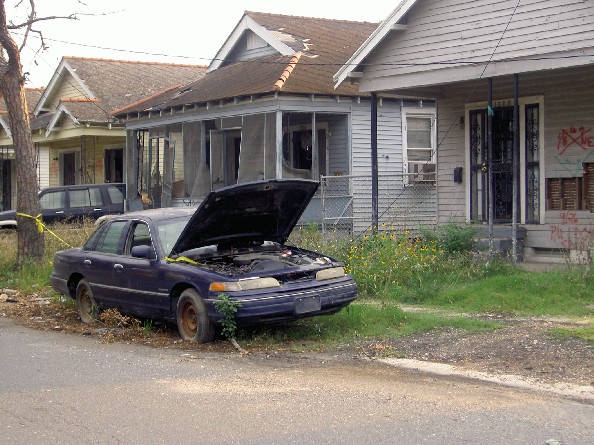
I didn't take any photos while I walked because I was too scared to think of taking any, but here's a photo of a run-down neighborhood in New Orleans that resembles the neighborhood I walked past in Montgomery.
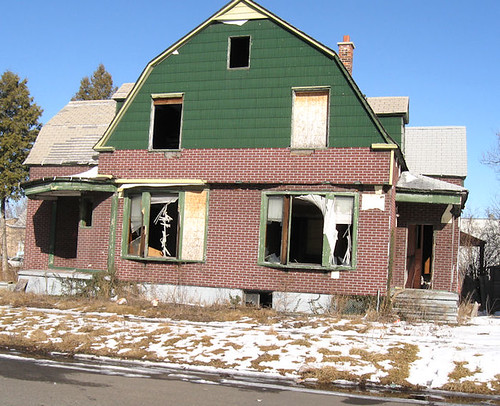
Again, not my picture. This is an abandoned house in Detroit, but there were many houses similar to this where I walked in Montgomery.
I followed the directions that Google Maps gave me to the tee, and up until the last street, they had been completely accurate. When I turned on the last street, which was supposed to be John Morris Ave., it was actually Hose Morace (???). I stopped for a moment, not knowing what to do, but then decided I had come too far not to continue. A not-too-menacing young black guy came around the corner by himself and looked at me strangely. I asked him if he knew where John Morris Ave. was. He said he didn't, but that I should not go down "Hose Morace" any further unless I wanted to be "cut." Specifically, he said, "They'll cut you if you go down there." Luckily, he showed me a shortcut out of that area. I took off quickly, not really comprehending all that had just taken place.
By this point, I was despondent. I headed back to the bus station in tears, still confused. Of course, I should have gotten a hold of someone from the church before I had even left Kansas City, and in fact, I had tried. No one had picked up, nor was there an answering machine to take any information. For whatever reason, I had decided that pressing on was the right thing to do anyway. I believed that the Lord would take care of it and he did, but it certainly wasn't in the manner I had expected.
As I walked back the way I had come, I felt utterly alone. I was in a section of town where I could potentially be killed and all I wanted was to see a friendly face who could point me in the right direction. I felt like I was failing the Lord by not pressing on to find the church. All I wanted to do was sleep, but more than that, I wanted to leave the hellhole that was Montgomery (no offense if there are any Montgomery readers out there, but this is the only experience I've had with your town). I felt like I had failed somehow, but I also felt like I had followed God completely. Had I misheard Him?
I arrived back at the bus station, and knew I had to get ahold of my cousins, Jesse and Maureen in Fort Worth, Texas. I had already made plans to go there this coming weekend, but I needed to go now. Thankfully, they were both very accommodating to this abrupt change. I got a 2:25 pm ticket on Tuesday – less than five hours after I had first gotten there – and headed out.
Even at this early stage, I feel like the Lord's shown me a few things. One: I wasn't supposed to go any further. I had walked close to 3 miles to the "church" and 3 miles back to the Greyhound only to cultivate more sorrow and despair. Two: it was no accident that I heard to go to that church from the Lord. He knew that I would try to walk there despite the state I was in and despite my surroundings. This might sound strange to some, but.... Three: because I tried to go to the church – which may not even exist, despite Google Maps - I feel like He has told me I have been faithful to Him in this, and that I'm willing to walk wherever. For a few hours anyway, with all my bags on my back and in a completely dangerous part of town, I knew what it was like to be completely homeless and scared. Besides the Lord, I had no one with me when I walked: no parent, no spouse, no friend could have helped me if I would have walked into a situation where I could have been hurt or killed. Four: once I got on the bus to go Fort Worth, my spirits instantly lifted and I felt the Lord's presence with me. It was incredibly comforting, and I doubt he would bless me with His Presence if I had failed him in any way. Five: on a more practical note, I'm now calling and making contact with every church I believe I'm supposed to go to before I get there. I'm sure I will learn more from this experience as time goes on, but I know, despite my initial ignorance and the intensity of the situation, my time in Montgomery was not in vain.
Looking outside myself and just within the area I was walking, the poverty found in Montgomery is striking. As I mentioned before, run-down, abandoned houses are everywhere. It's also very obvious that gangs and drugs run rampant in this section of town. Pimped-out cars are in front of trashy houses. Young men wear designer clothes, but still beg for money. It's a very strange and striking contrast to what I've seen so far. Unless I had a black tour guide, it was definitely somewhere I didn't need to be. Praise God that He got me out of there when He did, but it's still a place that needs and deserves prayer.

Here is a recreation of me walking down the side of the road in Alabama with all my stuff. This is pretty accurate, although the bike lane was a tad wider.
Monday, April 18, 2011
Hope City - Kansas City, Missouri

The front of the Hope City building

Part of the cafeteria at Hope City
I don't want to go too in-depth in regards to Hope City. You can find general information about the outreach at their website here. For those who want a brief synopsis, it's an outreach dedicated to the poverty-stricken, the homeless, and those addicted to substances in inner-city Kansas City, Missouri. They provide lunch seven days a week and dinners on Monday and Friday nights. There are facilities where people can take showers and wash their clothes. There are programs to help children stay off of the streets. Finally, there is a prayer room that functions as a ministry center for worship and corporate prayer. They have worship and prayer there from eight in the morning until ten at night and anyone can attend. Sadly, I was unable to take a picture of the prayer room, but it had a modern rustic feel.
As far as my own experiences went, Hope City felt like a great place to attend if you were experiencing poverty, as far as general services like food and showers were concerned. It seemed to lack the welcoming community feel of Home PDX in Portland, though. Several times I walked back and forth between the cafeteria and the prayer/worship room and I saw many people just sitting alone at tables, sipping coffee. Perhaps it was their choice to be alone, perhaps not. Nevertheless, after seeing the homeless engaged on a personal level at Home PDX, Hope City felt removed. They place a strong emphasis on prayer and worship, and rightfully so to an extent. For the most part, though, it seemed there was a strong divide between the poverty-stricken outside the prayer/worship room and those who weren't experiencing poverty within the worship room. There's no worship at Home PDX, per say, but the act of fellowship between those experiencing poverty certainly felt like a pleasing act of worship towards the Lord. To be fair, Hope City is a much larger outreach with varying programs, and since I only attended on a Friday night, I can't say if the atmosphere feels different throughout the week. Also, from the way Ken Loyd, the leader of Home PDX, explained, it took years before Home PDX began to foster that sense of love and community that, to me, felt effortless. For Hope City to cultivate consistent community, whether worshiping or otherwise, may just be a matter of time.
While I didn't attend Hope City to chronicle children, they did impress me with their children's ministry. Simply by looking at the smiles on the children's faces, I could tell the helpers were blessing the kids and making an impact on their lives. One pre-teen girl stopped and asked me to take her picture. I didn't get her name, but her joy and enthusiasm made me smile.

I met with a helper at Hope City named Ezekiel who isn't currently experiencing poverty, but grew up in absolute mental, spiritual, and economic poverty. His story is a testament to those who may feel there is no way out of their current dark conditions. That should be posted tomorrow or Wednesday at the latest.
Thanks again for reading! I feel like this blog, and by proxy, the book that will result from it, is only part of a larger concept that the Lord wants to fulfill. I'm not sure about all the details yet, but exciting things are coming from this endeavor. More soon.
Subscribe to:
Posts (Atom)